
This isn’t a trend piece. It’s an 11-slide data report built from 2024–2026 research — covering the AI search shift, the zero-click reality, and what it actually means for businesses trying to be found. If you’ve noticed your traffic behaving strangely, or you’re wondering why Google feels different, this is the briefing you need. The numbers aren’t alarming for the sake of alarming. They’re clarifying. And clarity is where strategy starts.
The Full Report: 11 Slides on the AI Search Shift
Discover how AI summaries are replacing traditional search…
What follows is a summary of the data in the report above. If you prefer to scan, start here.
AI Activity Is Reshaping Search: What the Data Actually Shows
For 25 years, the search engine was the gateway to the internet. Users typed a query, got a list of links, clicked through. That model is collapsing.
According to Graphite.io’s March 2026 data:
-
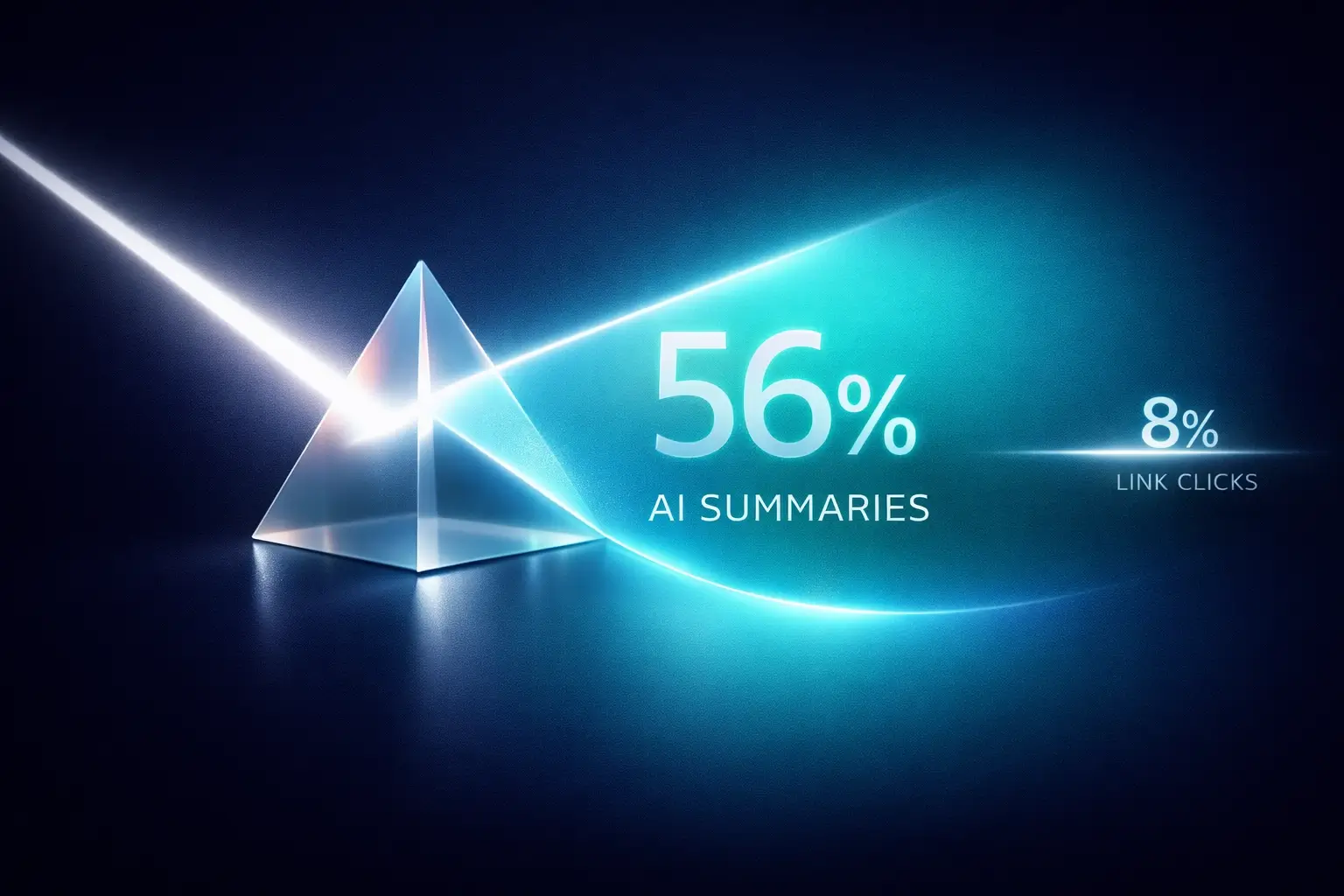
- Monthly AI-tool sessions are estimated at 56% of traditional-search sessions worldwide; search-like AI prompting accounts for an estimated 28% of search volume worldwide. U.S. AI usage is growing at 300% year-over-year.
-
- 44% of AI users now say it is their primary information source (McKinsey, October 2025).
-
- AI traffic has grown sevenfold since 2024 and is accelerating (CPA Practice Advisor, January 2026).
That is not incremental growth. It represents a significant and accelerating shift in how people access information.
Organic CTR Fell 61%: That Is Not a Dip
The numbers are not ambiguous.
-
- Organic CTR has dropped 61% for queries where AI summaries appear, falling from 1.76% to 0.61%.
-
- Even paid CTR takes the hit, dropping from 19.7% to 6.34% when an AI Overview is present (Seer Interactive, September 2025).
-
- 60% of all searches now end without a single click to any website.
-
- When users do see an AI summary, only 8% click through to a traditional search result when an AI summary is present, compared to 15% when no AI summary appears (Pew Research, July 2025).
That gap is not a rounding error. It is the difference between being found and being forgotten.
The Ghost Problem: Cited Without the Click
This is a specific kind of invisibility that is new to the internet.
Someone asks AI a question. An AI search system may retrieve and summarize your website when generating a response, drawing on your content’s expertise and credibility signals. AI delivers the answer, your expertise woven into the response, often without attribution.
No click. No visit. No lead. You provided the value. You did not get the credit. No notification that any of it occurred.
This is the difference between being the source and being the ghost. You influenced the decision. Your expertise shaped the answer. But you did not get the client.
If you are not being cited, you are not in the decision.
This is what we call the Source Attribution Gap. [Read the full framework in Brief 2: From Scattered Marketing to Structured Authority]
Who AI Search Is Hitting Hardest: Is Yours One of These Four Industries?
No industry is untouched, but the shift has hit hardest where the stakes are highest. Fifty-five percent of all LLM-sourced sessions are concentrated in legal, finance, health, and small business queries (Ronin Management).
In those sectors AI is not a convenience tool. It is the primary researcher.
-
- Legal services and healthcare face the highest impact as top LLM query categories.
-
- Financial services, small retail, restaurants, real estate, and travel are all seeing AI-driven discovery replace traditional search patterns.
If your business is not being cited by the model, you are invisible to nearly half of the people looking for exactly what you do.
Search Traffic Down Over 55%: A Measurable Decline
This is not theoretical.
-
- Business Insider reported a 55% collapse in monthly search traffic between April 2022 and April 2025, coinciding with the expansion of AI Overviews and other changes over that period. (See: How AI framing affects your brand.)
-
- Retailers and media companies are reporting traffic drops of 20 to 40% across categories. Informational sites have seen a 241% increase in AI summary appearances, meaning their content is being used more while their sites are visited less.
-
- Across the board, average organic sites face declines between 15% and 64%, depending on industry (Forbes, April 2025).
The range is wide. The direction is always the same.
If your business is not being cited by the model, you are invisible to nearly half of the people looking for exactly what you do.
Want to Get Cited? Do These Three Things
The businesses that earn citation share three characteristics, and they are harder to fake than anything SEO ever required.
- Specificity over fluff. Not “compassionate care” or “empower your best self.” Name the problem precisely. Explain the process honestly. Respect the reader’s intelligence.
- Your perspective over generic. AI can generate adequate summaries of what most people believe. It cannot generate what you specifically think based on your actual experience. The counterintuitive observation. The pattern you have seen repeat.
- A body of work over backlog. One article does not establish authority. Twelve articles circling the same problem from different angles tell AI what you are actually the expert on. Reputation is built through a consistent, recognizable presence over time.
The goal of content has changed. It is no longer to earn the click. It is to become the source.
Search Changed. The Strategy Has To
Search didn’t break overnight. It shifted. AI Overviews, zero-click results, and generative answers have quietly displaced the click-based model most businesses built their digital presence on. The businesses that adapt now, optimizing for how AI reads, cites, and trusts content — will be better positioned to compete for visibility and consideration. The ones that don’t won’t disappear. They’ll just become invisible.
This is the foundation behind everything we publish in the Omni Incite Brief: AI Search Strategy. If the report raised questions about where your business stands, start there.
Sources:
| Source | Finding | Date |
|---|---|---|
| Graphite.io | Monthly AI-tool sessions estimated at 56% of traditional-search sessions; search-like prompting ~28% of search volume worldwide. 300% YoY U.S. growth. | March 2026 |
| McKinsey | 44% of AI users say it is their primary information source | October 2025 |
| CPA Practice Advisor | AI traffic grown 7x since 2024 | January 2026 |
| Seer Interactive | Organic CTR drops from 1.76% to 0.61% with AI Overviews; Paid CTR from 19.7% to 6.34% | September 2025 |
| Pew Research Center | 8% click-through to traditional results when AI summary is present vs. 15% without an AI summary | July 2025 |
| Multiple studies | 60% of searches end with zero clicks | 2024-2025 |
| Ronin Management | 55% of LLM-sourced sessions in Legal, Finance, Health, Small Business | 2025-2026 |
| Forbes | 15-64% organic traffic decline range post-AI Overview | April 2025 |
| Business Insider (reported) | 55% search traffic collapse over 3 years (Apr 2022-Apr 2025) | 2025 |
| Industry data | 20-40% traffic drops for retailers and media<a href=”https://www.digitalinformationworld.com/2025/08/google-defends-ai-search-features-as-publishers-report-traffic-losses.html” target=”_blank”>Business Insider (reported)</a> — 55% Search Traffic Collapse, 2025 | 2024-2025 |
| Industry data | 241% increase in AI summary appearances for informational sites | 2024-2025 |