The Omni Incite Brief — Volume 2
From Scattered Marketing to Structured Authority
Your business is already being interpreted by AI. Not just indexed. Interpreted. To bridge the gap, you need Structured Authority. Today, most businesses are invisible because their expertise is not recognizable. Omni Incite fixes the diagnosis first. Not the symptoms.
By Miriam Kraay
Omni Incite
How Omni Incite helps businesses diagnose the real constraint, clarify their market position, and build visibility that earns trust from both people and AI
Most businesses I work with are not struggling because they are not trying.
They’re struggling because they’re busy doing the wrong things in the wrong order, and nobody has told them.
Last year, I sat across from a clinical director who had spent 18 months and close to $60,000 on SEO, content marketing, and a brand refresh. Her treatment center had 15 years of outcomes data, a team with real credentials, and the kind of expertise that takes a career to build. She should have been the authority in her space.
Instead, when I asked ChatGPT which were the top residential programs in her region, her center didn’t appear. When I asked Google’s AI Overview, it showed up, with a caveat pulled from a four-year-old complaint on a forum she didn’t even know existed.
She didn’t have a marketing problem. She had a diagnosis problem. Nobody had told her what was actually wrong before selling her the fix.
That’s where good businesses start wasting time. And that’s what Omni Incite exists to correct.
Strategic Marketing Positioning: Why Your Business is Invisible to AI
At Omni Incite, we call this Structured Authority—the process of turning latent expertise into a machine-readable reputation.
Business owners have 10,000 things to do. Marketing feels “done” because the website exists, the logo looks fine, and nobody complained. So it falls to the bottom of the list. Not because they don’t care, but because there is no visible urgency.
The problem is that the thing that is broken does not look broken. There is no alarm going off. No red light on the dashboard. The website still loads. The phone still rings (sometimes). So why would you prioritize a diagnostic you don’t know you need?
I see this constantly. Here’s what it actually looks like:
1. Activity Without a Strategic Sequence
Why doing the right things in the wrong order is a very expensive mistake.
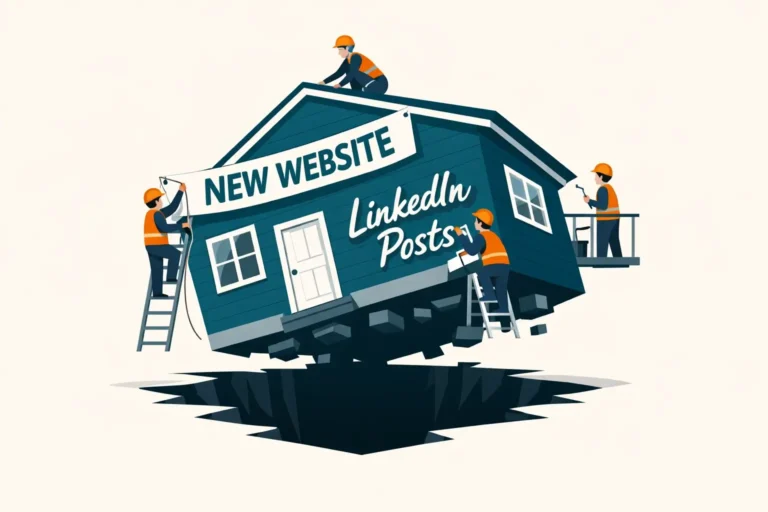
A business coach I consulted with had done all the “right” things. New website. Weekly blog. LinkedIn posts. Podcast appearances. Email sequences. She was producing more content than her competitors combined.
None of it was working.
When I looked at the full picture, the issue was obvious: she was rewriting her messaging every quarter because it never felt right — but she hadn’t defined her positioning first.
She was decorating a house with no foundation. Every new agency she hired started with tactics. Nobody started with the question: What should this business actually be known for?
That’s not a content problem. That’s a sequence problem.
2. AI Doesn't Know I Am an Expert: Latent Experience
Your expertise is real. Your AI Signal is Zero. Being the expert doesn’t matter if AI doesn’t know you exist.
This is the problem I keep seeing in the mental health and professional services space. The founder or clinician is genuinely brilliant. They’ve spent 20 years doing the work. They know more about their field than most people ever will.
But none of that knowledge lives anywhere except in their head and in conversation.
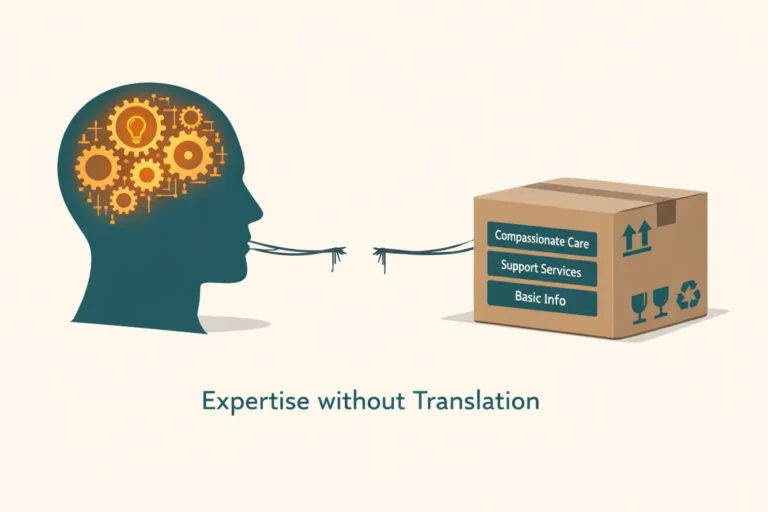
Their website says “compassionate, evidence-based care in a supportive environment.” So does every competitor’s.
Their expertise is real, but their content, written by a helpful freelancer, is interchangeable. And when AI systems today try to figure out who the authority is in that space, they find nothing distinctive to work with; there is no credit visibility, so the algorithm selects who they think is most credible or has the most latent experience.
The knowledge is there. The translation isn’t.
3. Why Others are Getting Credit for Your Ideas: Visibility without Credit
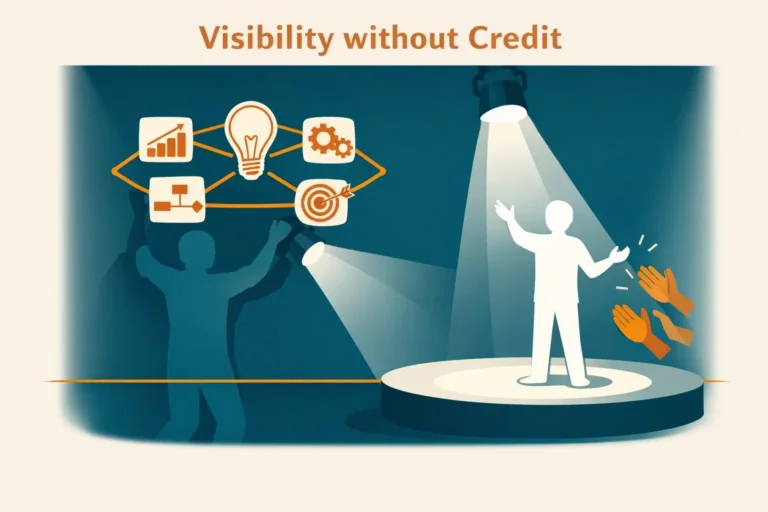
This one stings. I worked with a founder whose original thinking on a niche business topic was showing up, paraphrased, uncredited, in AI-generated answers, competitor blog posts, and even in a keynote at an industry conference. Her frameworks were everywhere. Her name was nowhere.
She was the ghost who powered someone else’s answer. And she didn’t even realize it was happening until we ran a source audit.
This is what I call the source attribution gap, and it’s more common than anyone wants to admit. Being influential in substance while being invisible in attribution is not a branding failure.
It’s an infrastructure failure.
And the thing is that most businesses don’t know the infrastructure exists. As I often say, it is not their fault that they don’t know what they don’t know.
The result is a lot of busy marketing content, but a failure to build your own brand. You are an expert contributor without an identity.
If your content doesn’t have the “infrastructure that can translate” your content into machine-readable and specific, unambiguous instructions, AKA “AI Speak,” then you are leaving your reputation to chance.
Without structure, you could be misquoted, unrepresented, or even hallucinated into a version of yourself you cannot recognize.
Does your website speak "AI Geek"?
If you don’t know if your website has the right AEO infrastructure, you’re a ghost in the machine.
AI can’t credit what it can’t clearly read. We run a full diagnosis to see whether you are using schema, and how it’s being used, as well as what format you are using. (JSON-LD or TOON).
Generative Engine Optimization (GEO) and Answer Engine Optimization (AEO) Audits will assess whether the machine can recognize your content, its structure and you as an expert.
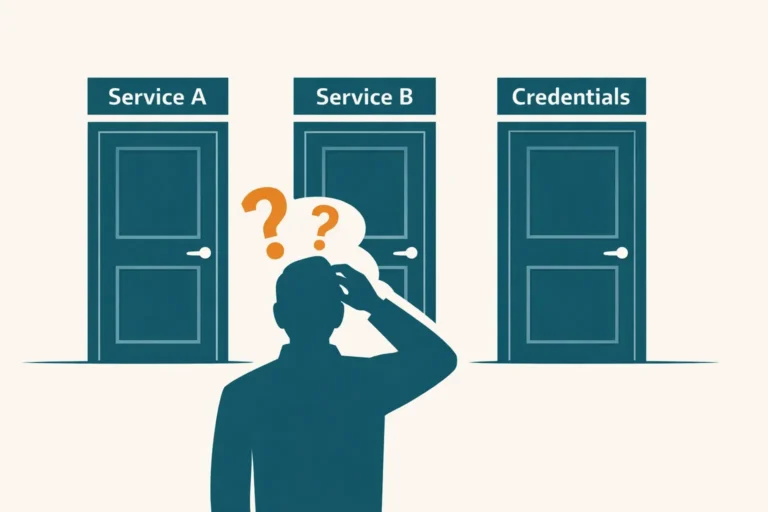
4. Conversion Focused Copy: Can Your Website Answer "Why You"? If Not, Neither Can AI
- They inform without distinguishing.
- They describe without clarifying.
- They leave too much interpretive work to the buyer.
And in the age of LLMs and AI Summaries or AI responses, we have a new zero-click reality: The buyer doesn’t do that research work anymore. They may not even visit your website. Zero Click is when the consumer asks or expects AI to narrow down their choices. Here are some staggering statistics you may or may not be aware of:
- As of the end of March 2026, 60–68% of all searches now end without a click because the AI agent answers the user directly.
- For businesses that rely on traditional SEO, the click-through rates have dropped by 34.5%.
- Experts predict that 25% of B2B traffic will decline as zero click becomes the norm.
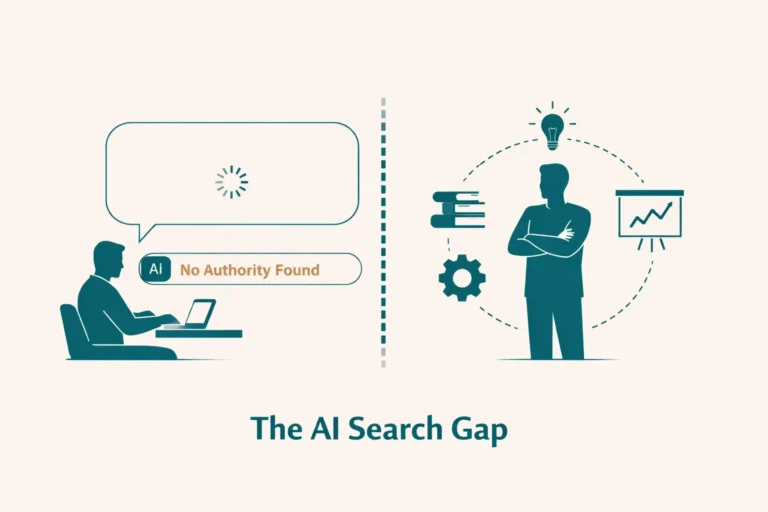
5. The AI Search Gap: Tell Us Who You Are or the Internet Will
AI does not have a “no results found” setting.
Most business websites were not built for the AI/LLM era. They were built in 2015 or 2020 by a marketing agency that delivered “professional” copy no one ever revisited.
The homepage says “We are a leading provider of innovative solutions.” The blog has twelve posts from three years ago, half of them written by someone who no longer works there.
The service pages describe what you do in language so general that any competitor in your industry could paste it onto their own site without changing a word.
That is not just stale content. That is the data AI is reading right now to decide whether you are worth citing.
AI does not distinguish between “old content you forgot about” and “content that represents you.” It reads what is there. And if what is there is shallow, generic, AI-generated filler, or outdated agency work with no original voice or purpose — that becomes your digital identity. This isn’t just a content gap; it’s a failure of your AI search strategy for business.
Not because you chose it.
Because you never replaced it.
Because we become complacent, and especially in SMB, we run with, “if it ain’t broke, don’t fix it.”
And it gets worse. If you know the content may be out of date and you’ve heard the noise, did you go get some ChatGPT content?
Or did you hire a freelancer to “freshen up your site”?
Did you inadvertently replace one problem with another?
There’s an aha moment when you realize that AI does not have a “no results found” setting.
If your structured content is absent, AI fills the void with whatever else it can find:
- A four-year-old Reddit complaint
- A Glassdoor review from a disgruntled intern
- A competitor’s framing of your industry
- An outdated directory listing with details from 2001.
- If your industry has been involved in scandals, then it could be an anti-industry spokesperson or an activist group that tells AI who tells your prospects who you are.
I call this unstructured noise — and it is not random. Unstructured noise is what happens when you don’t have Structured Authority.
The loudest, most findable content wins, regardless of whether it is accurate, fair, or current.
Most businesses do not know the noise exists until a client, a referral partner, or a prospective hire tells them what AI said about them. By then, your reputation is built, and it’s spreading like wildfire.
The absence of your signal is not silence. It is an invitation for unstructured noise to speak on your behalf.
Our Belief: Diagnosis before Intervention
What AI Actually Trusts
Today, many agencies, consultants, and AI tools start with a recommendation.
Fix your SEO.
Optimize your content for ChatGPT and Gemini.
Publish more blogs, build a new email sequence.
Publish on LinkedIn 5x a week to stay relevant.
Build topical authority by publishing on Medium.
Start a podcast.
Run ads.
This one is my favorite: Build a Digital Twin or an AI Persona that can write just like you.
If you take away one thing from this article, don’t give someone your old emails to train a GPT or “Agent”, and no matter how good it sounds, do not buy a Copywriter Agent.
This market created an opportunity for many to prescribe before they diagnose.
My advice: avoid the platform of the day.
Your authority won’t be found in Podcasting, Medium, Substack.
A podcast, when done right, can be a great resource, but when done quickly and “on a budget,” it’s more likely to become another digital orphan for someone to adopt.
Lastly, if anyone tells you SEO is dead, just hang up or delete their email. It is not in your best interest to buy an “AI overhaul package.”
One of my clients recently heard from an agency they worked with some years ago: Google is dying, you need to pay us $10k to “Optimize for ChatGPT immediately.”
You don’t need a new trick, you need a diagnosis of why your current signal is zero.
Most of these are just sophisticated ways to ask you to ‘Speak Louder.’ None of them help you ‘Speak Clearer’ to the machines that are already judging your credibility.”
The Omni Incite Method
Omni exists to ask a different question first: what’s actually broken?
We help businesses identify the real constraint — then determine the right response, the right order of action, and the right level of investment.
That is not hesitation. It’s discipline. Discipline and perspective that comes from 30 years of “Online” experience. Yes, I was there at the beginning, and I’m here today, watching trends that would change the Online world. And while some have, most of what’s changed is the medium and the how-to, not the process.
Perspective grounded in experience: The one thing AI cannot fake.
In a world of instant content generation, what stands out is lived understanding:
- Truth – What’s limiting your revenue growth?
- Lane – What is the right strategy for YOU.
- Architecture – What must be built vs. what can be optimized?
- Cadence – What is the right rhythm for execution?
- Compounding – Build authority that compounds over time, that doesn’t become stale news.
Our work follows a disciplined progression. Five stages, each one matters for a reason; the order is non-negotiable. This cannot be fabricated.
We do not sell checklists; it is not rebranding, it is not rehashing what you know.
It’s the work of making your business legible, credible and selectable, by both humans and AI systems.
Who We Help
Omni works best for businesses that already have real expertise but whose market presence doesn’t reflect it.
Often, these are founder-led firms, expert-led service businesses, or organizations in high-trust categories — mental health, professional services, specialized consulting — where authority depends on discernment rather than commodity scale.
These businesses don’t need louder marketing. They need a more accurate understanding of what’s actually holding them back, and a more disciplined system for making their authority visible.
If that sounds like your situation, it probably is.
Businesses are now being interpreted, summarized, and compared by AI systems that don’t reward activity. They infer meaning from patterns, signals, structure, and clarity. A business that is genuinely good but poorly structured is at a disadvantage against a mediocre competitor with better packaging.
It is no longer enough to be good. A business now needs to be interpretable. Credible in structure, not just in conversation. Clear enough to be recognized, trusted, and cited.
That’s the shift. And it’s the one Omni Incite helps businesses navigate — not by chasing the shift, but by building something that holds regardless of what changes next.
The Real Questions: What you actually need to know
Does this mean I have to stop using ChatGPT to write my blogs?
No. But you do have to stop letting it write for you.
There’s lots of value in using AI to help you draft an outline, research a topic, or edit, but you cannot let AI do your thinking for you; your voice and experience are what make you credible in the first place.
Think of this: AI-generated content takes everyone’s ideas and generalizes them into something that sounds good and can be on anyone’s website. The resulting copy is clean, competent, and completely interchangeable with every other business in your category that did the same thing.
Do you not think that it will recognize its own writing? It will, in the end, save time, but you also told the most powerful credibility auditor that you have nothing original to say. That you want it to use its knowledge to pretend to write like you.
Your expertise is the one thing AI cannot emulate; it’s what makes you authentic. Do not hand it over to save an afternoon.
How long does it take for AI to 'recognize' my new structure?
Are you asking how long it takes for your content to appear in the AI Summary? It can be quick, a few days even. LLMs like fresh content, that’s their chum, fresh food, give me, give me!
With that said, I’ve seen reports saying content older than 14 days is less likely to be cited; instead, they are always looking for what’s “fresh.”
Truthfully, I don’t think we know exactly when they flip the switch. These companies share guidance, not their algorithms.
Some use live search and then process millions of data points in seconds, so whatever is easiest for them to understand becomes their source.
I tell my clients, ” Don’t worry about the clock. Focus on having something that is worth citing and the structure they can read.
It’s not about time is about the quality of the response.
Is an AEO Audit just a fancy word for SEO?
No. And if someone tells you it is, they are selling you 2020 thinking with a 2026 label on it.
SEO (Search Engine Optimization) is the method used for search engines to find and rank your pages. That has not changed. If anyone tells you SEO doesn’t matter now, is trying to sell you the replacement.
AEO (Answer Engine Optimization): asks when AI gathers information to answer a question in your field, is your content and your name (source-citation) included in the response.
You can rank #1 on Google and still be completely invisible in AI-generated answers. Those are two different systems, they don’t talk to each other.
SEO results are impacted by keywords, backlinks, and technical structure.
AEO results seek clarity, authoritative signals, structured data, and evidence that your content actually answers the question in a way AI can extract and attribute.
An AEO audit looks at what AI systems can see when they look at your business. Not just whether your pages are indexed, but whether your expertise is interpretable, your authority is verifiable.
Think of it this way: SEO gets you on the field. AEO gets you in the answer. They are related. They are not the same.
Can’t I just hire an AI Agent to do all this 'AI Speak' and content work for me?
You can! In the right environment, you should. AI agents are incredible tools for scaling your reach or improving your operations.
Think of AI Agents as processors, not architects.
Here’s the catch: An AI Agent is a high-speed engine, but it doesn’t build the track. If you set an agent loose on a business with ‘Unstructured Noise,‘ it will simply amplify that noise faster than any human could. It will hallucinate more efficiently and misquote you more broadly.
I am not anti-agent, but before you go that route, please make sure you have a ‘source of truth’; think of it as a map that will guide your agent. Otherwise, you’ve hired a driver to get you from London to Paris, but gave him the map with the route from Victoria, BC, to Hong Kong. Absurd, right? That is exactly what happens when an AI Agent tries to navigate a business with no source of truth.
Sources:
- IDC and industry data confirm B2B companies face a potential 25% traffic decline as zero-click AI answers handle queries directly.
- Click-through rates have dropped approximately 34.5% for businesses relying solely on organic rankings.
- According to multiple industry analyses through Q1 2026, 60–68% of all searches now end without a click. SparkToro / Datos (Semrush)
About the Author

Miriam Kraay is the founder of Omni Incite, a strategic marketing consultancy. She works with founders and business owners who are good at what they do and tired of being invisible.