The Omni Incite Brief — Volume 3
How Small Businesses Build Trust in AI Search
Build authority with 6 specific moves to increase your business AI visibility. Our GEO Checklist for Founders is designed for SMBs that don’t have a PR team or a big marketing budget.
By Miriam Kraay
Omni Incite
Why do some businesses get cited by AI while others stay invisible?
Diagnosis First. Then This.
In Brief 2, I argued diagnosis has to come before intervention. Stop chasing tactics before you know what’s broken.
This brief assumes you did that work. You know why your signal is zero. You know what’s holding your authority back.
Now you need the doing.
A Word Before We Start: Credit Visibility
You’ll see this phrase a lot in what follows. It’s worth defining once, cleanly.
Credit Visibility is what AI can see that tells it you did the work, and that the work is yours.
Every tactic in this brief is a Credit Visibility move. Citations make your claims traceable. Attributed quotes put your name on your expertise. Your own statistics can’t be borrowed. Schema tells the machines who you are. Each one adds a signal. Together they build the trust AI uses to decide who to cite.
Borrowed Authority
Borrowed Authority is credit you rent from someone else’s platform.
Your Google Business Profile. Your Yelp listing. Your Facebook page. The feature article the local paper ran about you in 2022. The directory that put you in their top-ten roundup.
Every one of those signals AI that you exist. None of them belongs to you.
If Google Business changes its display rules tomorrow, your Borrowed Authority changes too. You don’t own the terms.

Built Authority
Built Authority is Credit Visibility that lives on your own ground.
Your website. Your case studies. Your published statistics. Your schema markup. The quotes attributed to you by name. The body of work that compounds every time you add to it.
Built Authority doesn’t depend on anyone else’s platform rules. It’s the trust you own.
Which is why, when the rules change — and they will — Built Authority is the one that holds.
Another way to think of it:
Borrowed authority is like setting up a shop inside Macy’s. You benefit from Macy’s foot traffic, reputation and built-in trust.
Built authority is when customers know your brand well enough to search for it by name, whether it is inside Macy’s or not.
Borrowed authority may help people discover you. Built authority is when people know your business and search for it by name.
Enterprise GEO Assumptions Don't Translate for Small Business
The advice and checklists you find online about AI search and AI Engine Optimization (AEO) were written for enterprise, SaaS and Fortune 500 businesses with marketing budgets and teams. Those methods do work for those companies, but do not work for small to medium-sized businesses.
For the rest of us:
- The therapist running her own practice,
- The coach with a Gumroad store
- The founder with one VA
- The treatment center with a WordPress website.
It’s a reminder that the GEO checklist is a borrowed map. Real terrain. Someone else’s.
The question this brief answers is:
What does GEO look like for a small to midsize business that has to build its authority from scratch?
What the research gets right
The most useful GEO research I’ve read highlights the transformation of search. Traditional search has been replaced by an AI that provides real answers. When a user asks a question inside Google, ChatGPT, Perplexity, Claude or Copilot, AI finds the answers it thinks you need and presents an AI summary.
The conversation often ends there. No click. No visit to the website that actually had the answers.
According to Gartner, Google’s traffic will decline by half by 2028. If your business depends on organic traffic, that should set you on fire.
OtterlyAI tracked 1.4 million AI-related citations in one month in 2025. More than half, 51.3% of the citations pointed to business-owned sites. News and media ranked second. Reddit third. Wikipedia came fourth.
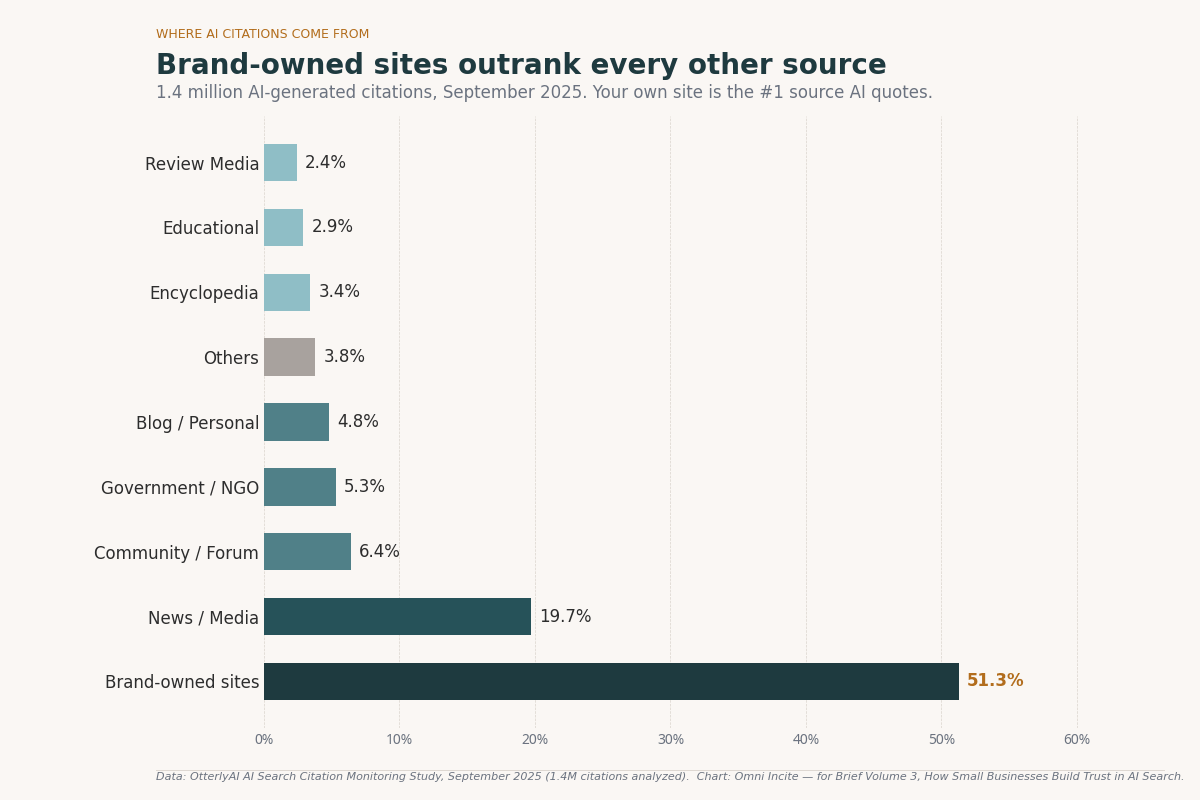
The good news is that business websites outperformed news sites and even Wikipedia.
Your own site, built right, is the #1 source for AI search to quote.
Princeton researchers reviewed 10,000 real searches and tested which content tweaks made AI pay attention.
Three moves worked almost every time:
- credible citations
- direct quotations
- unique statistics
Each one increased visibility by approximately 40%. So there are very specific tactics small businesses can use to become the structured authority.
What I take issue with
What I take issue with are the “how-to” guides we see online. There are five assumptions made in most GEO playbooks, and it’s important to validate them.
You have a PR Agency on retainer
The advice is “Contact your PR agency to get your brand mentioned alongside relevant topics.”
A small retainer with a boutique PR firm runs $5,000–$15,000 a month. For most SMBs, that isn’t a marketing line item — it’s closer to a second payroll.
"Get" a Wikipedia page
Wikipedia is real; AI was trained on it, and statistics show that AI summaries rely on it three to five times more than other sources.
The question isn’t whether Wikipedia works. It does.
The question is whether you qualify.
Wikipedia requires significant independent coverage from reliable sources for a page to pass a notability review. Most small businesses do not meet this requirement. I’ve watched founders spend three weekends drafting a page that gets nominated for deletion within 48 hours.
Don’t waste your time.
03
You Need Earned-Media
“Get quoted in industry publications.” Good advice — if a journalist already takes your call.
It’s a time-consuming process: it requires pitching multiple times to multiple publications, and it can take years to build enough authority to become a quoted source in your industry.
Google Page One (SEO & Rankings)
A few years ago, if you ranked on Google’s first page, you’d also show up in AI search. Not anymore.
Ahrefs tracked the overlap from 76% in July 2025 down to 38% by March 2026.
Rank and AI citation are decoupling, which is different from what SEO agencies have been telling us for twenty years.
Backlinks matter less, which is different from what SEO agencies have been telling us for the last twenty years.
The rules have changed and will keep changing. So what are small businesses supposed to do?
Here's What Works Without a Marketing or PR Team
Six things you can do this week to start building trust in AI search
Cite Generously
Update the content you already have, add credible citations, quotes and statistics and link to the sources.
Freshen the formatting so it is easier for AI to understand what you are saying, without losing the human voice.
AI tends to favor pages that make claims they can support.
Every citation you add is a Credit Visibility signal. You’re telling AI: this claim is supported, this page did the work, this source is worth trusting.
Primary sources means government data (CDC, HHS, BLS), peer-reviewed journals, leading industry studies, and well-known research institutions. Not blog posts that cite blog posts.
Here’s a quick example:
Instead of saying: Teen anxiety is rising, and families are overwhelmed.
Say: Teen anxiety is rising, and many families feel like they are making high-stakes decisions without enough information. Recent CDC youth data helps explain why so many parents feel under pressure all the time.
If you can do one thing this week: go back to your three highest-traffic pages and strengthen any claims that need support, add credible sources to help the reader trust what you are saying.
Quote and Name Yourself as the Source
Because you are an expert in your business, a well-placed, attributed quote can increase visibility as a cited source by roughly 40%.
Jane Lohan, Director of Admissions, Best Known School, says: “The families who tour our campus are usually weighing three or four schools at once. What they remember afterward isn’t the facilities — it’s whether their kid lit up talking to a teacher in the hallway.”
These quotes can be extracted by AI and attributed to you.
You can do this too:
Interview clinicians in your practice and quote them on your content, including their names and credentials. Build or update older posts with this new content.
If you can do one thing this week:
Add a signed, attributed pull quote to the top of every service page.
Publish Your Own Statistics
You have data in your EMR or your CRM that is yours. Analyze it, then share the statistics on your website and social media. If you have intake assessments, school applications, or emails that came through your website, that is all the data you can use.
The SMB version is smaller and, in some ways, more powerful because the data is unique to you.
A proprietary stat is Credit Visibility; nobody can take it from you. Your competitor can borrow your framing; they can’t borrow your numbers.
Review your intake forms. Compare year-over-year bookings and publish the chart.
A therapist who writes “of the last 100 adolescents I assessed, 62% presented with overlapping anxiety and tech-use patterns” owns a stat nobody else has. That’s the kind of line AI lifts wholesale — because nobody else can.
If you can do one thing this week:
Mine your own data for one original stat and build a 400-word post around it.
Write for the 13-Word Prompt
SEO keywords ran 2 to 4 words. AI prompts average 13. That changes everything about how you write headings.
“Best CRM software” was an SEO target.
“What’s the best CRM for a solo consultant who bills by the hour and hates Salesforce” is an AI prompt.
The founder who writes that heading — verbatim — and answers it in a tight paragraph is more likely to show up in ChatGPT.
If you can do one thing this week:
Rewrite five section headings on your site as complete questions, in the actual voice of your actual customer.
Make Sure the Machines Can Actually Read You
This is the one tactic where a solo founder matches the enterprise budget. The work is free.
Two pieces matter:
First: a small block of invisible code on your site, your developer or your WordPress plugin calls it “structured data” or “schema.“
Schema tells AI, in plain machine-language:
- who you are
- what you do
- where you’re located
- which social, review and directory profiles belong to you — your Borrowed Authority signals, connected to the Built Authority of your own site
That connection is Credit Visibility, which the machines can read. Think of it as a business card written for a robot.
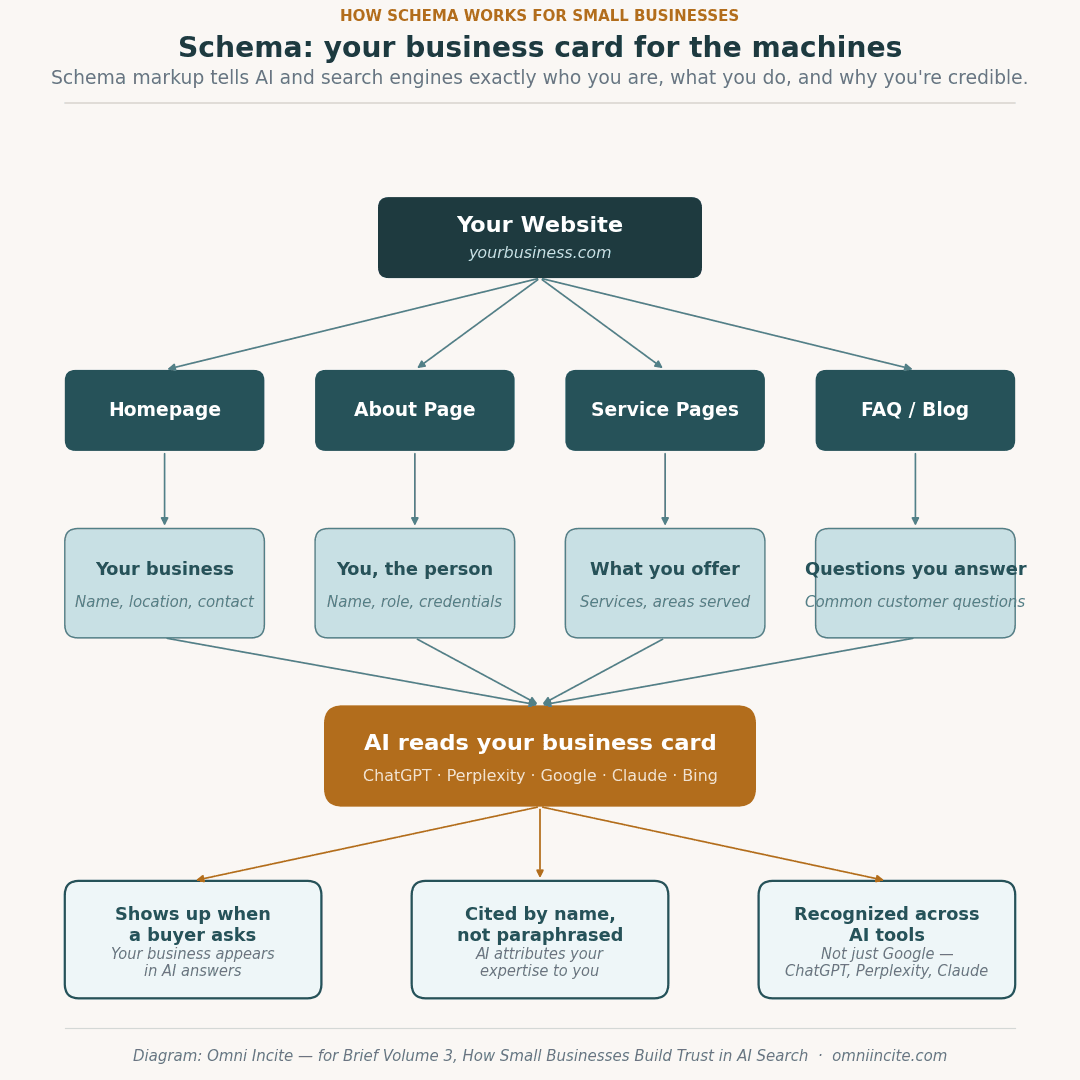
There are free, standard versions for businesses, individuals, local businesses, products, services, and FAQ pages. If your site doesn’t have one, AI is guessing. If it does, AI knows.
If you’re non-technical, this is cut-and-paste work, not a rebuild. Ask your developer, or use a schema plugin like Rank Math or Yoast. One afternoon. Not a replatforming project.
That’s a fixable problem that can be solved in one afternoon. It’s the difference between AI finding you and AI walking past you.
Forget Wikipedia. Show Up Where Reddit Showed Up.
Reddit — yes, Reddit — is 6.4% of AI citations.
That number should bother the marketing industry more than it does. It tells you AI trusts user-generated discussion more than it trusts most of what we produce.
You don’t need a subreddit of your own. You need to be the most substantive, helpful, non-pitchy voice in the three subreddits your buyer already lives in.
Same logic for Quora, niche Facebook groups and LinkedIn long-form.
The kind of presence that shows up here keeps compounding long after you stop feeding it, which is not something anyone can say about paid ads.
If you can do one thing this week: pick three forums your buyer actually uses and answer one question in each — with your real name, your real credentials, zero pitch.
Start to Build Authority in One Week
No PR firm. No Wikipedia page. No enterprise budget.
Two pages. Six moves. Completion criteria — not theory.
The Real Questions: What you actually need to know
Is GEO a waste of time when AI answers change every five minutes?
No — and that’s the wrong question.
OtterlyAI tested it: same prompt, twenty minutes apart, over and over. Rankings jittered. The brands at the top stayed at the top. If you’re in the set, you stay in the set.
The “ever-changing AI” hand-wave is mostly an excuse not to start.
Do I need to rebuild my whole site to do this AI-readable thing?
No. You need the right structured data blocks on the five pages your buyer actually lands on.
WordPress and Shopify have free plugins. Webflow handles it natively.
Anyone telling you this is a “replatforming project” is selling you a replatforming project.
I'm building a personal brand, do any of these tactics apply to me?
All of them. More cleanly than for a corporate brand, honestly.
A person-brand with consistent attribution, a well-marked About page, and one topic you’re known for is the kind of entity AI is actually learning to recognize right now. Corporate brands with fifty product lines and three sub-brands are harder for AI to get right, not easier.
Won't AI just scrape my content without sending me traffic?
Sometimes. But the people asking this are usually still measuring the wrong thing.
AI citation is the new Consumer Reports mention. It builds a mental shortcut, whether or not the user clicks.
Traffic is one metric. Citation presence is becoming another. Measure both.
Do I really have to participate on Reddit?
You have to show up where the actual conversations are. For most B2B and health-adjacent categories, that’s Reddit. For consumers, it’s TikTok comments and niche Facebook groups.
Reddit feels like walking into a bar where nobody invited you. Do it anyway — real name, real credentials, zero pitch.
That’s the whole tactic.
Sources & further reading
- OtterlyAI, GEO Guide: How to Win in AI Search (2025) — Klaus-M. Schremser and Thomas Peham
- OtterlyAI, AI Search Monitoring Study — 200,000 prompts, 1.4M citations (September 2025)
- Princeton University, GEO: Generative Engine Optimization study — 10,000-prompt benchmark
- Ahrefs, AI Overview Citation Studies (July 2025 + March 2026 updates)
- Gartner, forecast on organic search traffic decline to 2028
About the Author

Miriam Kraay is the founder of Omni Incite. This brief is the third in a series that translates frontier AI-search research into work that small businesses and solo operators can actually ship. Volume 1 outlined the AI search strategy framework. Volume 2 introduced Structured Authority. Volume 3 is about Borrowed Authority versus Built Authority — and why the second one is the one you can afford.